AI Stylist for Finding Clothes That Match Your Body Type: A Smart Guide
Discover how an AI stylist for finding clothes that match your body type helps you choose flattering fits, balance proportions, and build confidence. Learn body-type styling tips and how fAIshion personalizes recommendations for you.
Finding clothes that genuinely flatter your body is one of the most frustrating parts of shopping. Size charts are inconsistent. Fit models rarely match real bodies. And "one-size-fits-all" advice ignores the fact that proportions matter more than measurements. An AI stylist for finding clothes that match your body type changes the equation: instead of guessing what might work, you get recommendations built around your actual shape, proportions, and preferences.
Why Body Type Matters More Than Size
Clothing labels tell you width and length. They do not tell you where structure sits, how fabric drapes across curves, or whether a silhouette creates balance or imbalance. Two people with the same waist measurement can wear the same dress and look completely different—because one carries height in the torso, the other in the legs.
Body-type dressing is not about hiding or correcting. It is about proportion and visual balance. The goal is to create a silhouette that feels harmonious to your eye, using line, volume, and focal points. An AI stylist understands these relationships and applies them to real garments.
The Five Common Body Shape Categories
Most style systems use five broad shapes as starting points. These are not rigid boxes—many people blend two—but they give the AI a useful framework:
| Shape | Proportions | Styling Goal |
|---|---|---|
| Apple (Round/Oval) | Fuller midsection, slimmer limbs | Draw attention upward; create vertical lines |
| Pear (Triangle) | Narrower shoulders, wider hips | Balance upper and lower body; emphasize waist |
| Hourglass | Shoulders and hips similar, defined waist | Follow the natural curve; avoid boxy cuts |
| Rectangle (Straight) | Shoulders, waist, and hips roughly equal | Create definition at waist; add curves visually |
| Inverted Triangle | Broader shoulders, narrower hips | Soften shoulder line; add volume to lower half |
These categories are not about labeling. They are about pattern recognition: an AI trained on fit data and style rules can map garment attributes—neckline depth, hem length, shoulder construction, fabric weight—to the outcomes they create on each shape.
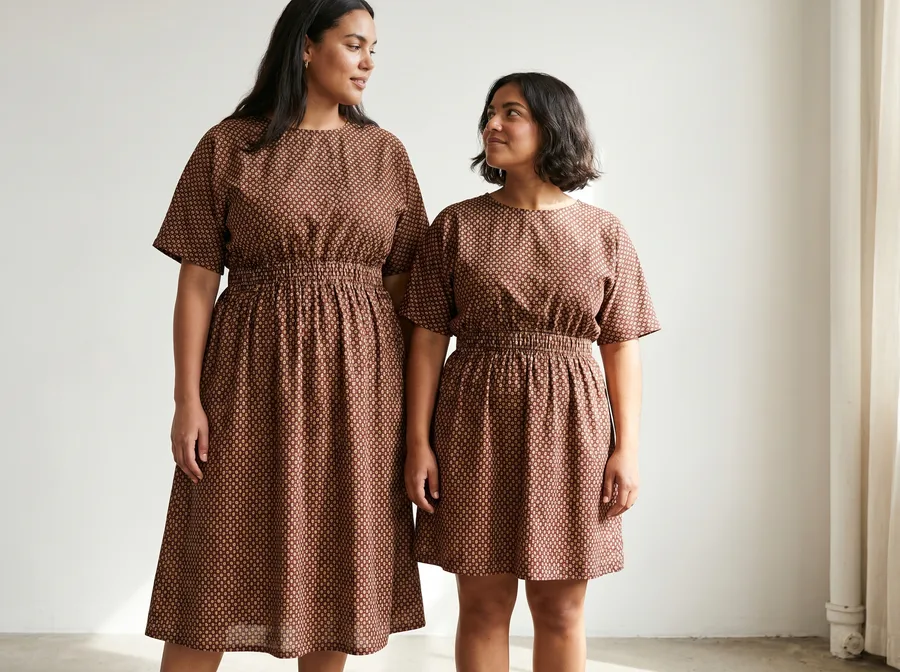
How an AI Stylist Reads Your Body Type
Traditional stylists assess clients in person: they look at posture, proportion, and movement. An AI stylist for finding clothes that match your body type does something similar through structured inputs and visual analysis.
Step 1: Capture Your Proportions
You provide a few measurements or answers: shoulder width relative to hips, where you typically gain weight, your best-fitting garment sizes, and what cuts have worked before. The AI uses this to place you on a proportion map—not to label you, but to understand your geometry.
Step 2: Learn From Your Preferences
You also tell the AI what you like. Maybe you hate belted dresses even though stylists say they suit you. Maybe you love oversized silhouettes despite having a petite frame. The AI weights your taste heavily. Body-type advice is a starting point, not a mandate.
Step 3: Match Garment Attributes to Outcomes
Every item in the AI's catalog is tagged with structural attributes: drop shoulder, A-line skirt, high-rise waist, structured bodice, fluid drape. The AI calculates how each attribute interacts with your proportions. A peplum top, for example, adds hip volume—great for inverted triangles, less useful for pears.
Styling Strategies by Body Shape
Here is how an AI stylist applies body-type logic in practice:
Apple Shape: Vertical Lines and Strategic Structure
- Best necklines: V-neck, scoop, and open collars that elongate the torso
- Best waist treatments: Empire lines, drop waists, or no waist emphasis at all
- Best lengths: Tops that hit at the hip bone to avoid cutting the body in half
- Fabrics to favor: Medium-weight knits and woven fabrics with gentle structure
- Avoid: Clingy jersey around the midsection, high necklines that shorten the torso
The AI will favor single-color columns, long open cardigans, and tops with interesting necklines that draw the eye upward.
Pear Shape: Balance and Waist Definition
- Best necklines: Boat neck, wide scoop, and off-shoulder to broaden shoulders visually
- Best bottoms: A-line skirts, wide-leg trousers, and dark-wash bootcut jeans
- Best jackets: Structured blazers and cropped jackets that end at the waist
- Fabrics to favor: Structured tops, fluid bottoms
- Avoid: Pencil skirts without balance on top, skinny jeans that emphasize hip width
The AI looks for top-half interest: bold colors, patterns, or shoulder detail paired with simpler bottoms.
Hourglass: Follow the Curve
- Best silhouettes: Wrap dresses, fit-and-flare, and anything that follows your waist
- Best waist treatments: Belts, seaming, and anything that highlights the narrowest point
- Best lengths: Anything proportionate to your height; avoid overly long lines that hide the waist
- Fabrics to favor: Stretch wovens, medium-weight knits that skim without clinging
- Avoid: Boxy cuts, sack dresses, and low-rise anything that breaks the waistline
The AI prioritizes waist visibility in every outfit build, because that is your natural strength.
Rectangle: Create Curves Visually
- Best waist treatments: Belts, peplums, color-blocking at the waist
- Best silhouettes: Sheath dresses with waist seaming, high-waisted trousers with tucked tops
- Best layers: Unbuttoned blazers and cardigans that create vertical lines inward at the waist
- Fabrics to favor: Soft fabrics that drape and hold shape at the waist
- Avoid: Straight-cut everything; it reinforces the rectangle rather than softening it
The AI experiments with asymmetry, ruching, and diagonal lines to break up the straight silhouette.
Inverted Triangle: Soften the Top, Build the Bottom
- Best necklines: Soft V-necks, narrow scoop, anything that narrows the shoulder visually
- Best bottoms: Full skirts, wide-leg pants, cargo trousers with volume
- Best jackets: Unstructured, no shoulder pads, ending at the hip
- Fabrics to favor: Soft, draping tops; structured or textured bottoms
- Avoid: Boat necks, puff sleeves, and anything that adds horizontal width at the shoulder
The AI balances every outfit by checking lower-body volume against upper-body width.
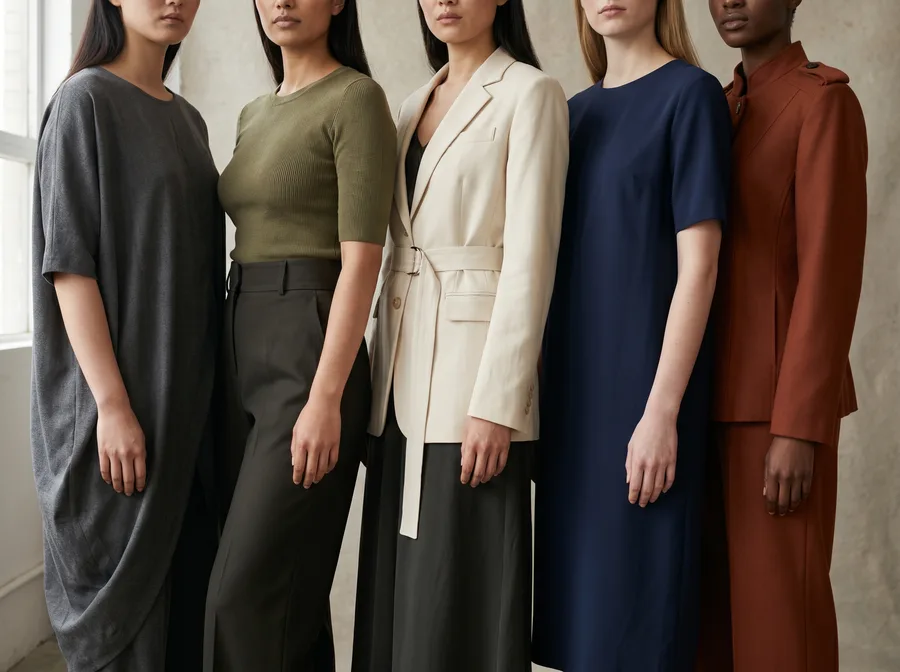
How fAIshion Personalizes Body-Type Styling
fAIshion's AI Stylist Agent goes beyond generic shape advice. Here is what makes it practical:
Wardrobe-Aware Recommendations
Save pieces you already own to Wardrobe, and the AI builds outfits from your actual closet. It will tell you which of your existing items flatter your shape and which gaps are worth filling. No more buying "perfect for pear shapes" pieces that clash with everything you own.
Mix Gallery Previews
Every recommendation opens in Mix Gallery so you see the full outfit on a rendered figure. You can evaluate proportion, balance, and line before you buy or wear. This is especially valuable for body-type dressing, because the same garment looks different depending on what surrounds it.
Natural Language Refinement
Ask the agent specific questions: "I have broad shoulders and narrow hips. What kind of summer dress balances me without looking bulky?" The agent returns reasoning, not just links. It explains why an A-line midi with a narrow neckline works, so you learn the rule and can apply it later.
Trending for Your Shape
Browse Trending with filters for body-type tags. See how other users with similar proportions solved the same problem: wedding guest outfits, interview looks, vacation packing. Community context makes abstract advice concrete.
Common Body-Type Mistakes AI Helps You Avoid
| Mistake | Why It Fails | The AI Fix |
|---|---|---|
| Buying for a shape you wish you had | Clothes never fit right; constant returns | Recommendations anchored to your actual proportions |
| Ignoring fabric behavior | A cut that works in cotton fails in silk | Fabric-weight tagging with fit predictions |
| Overcorrecting with volume | Adding too much structure looks costume-y | Balanced proportion scoring in Mix Gallery |
| Following trend over fit | Trendy cuts may not suit your frame | Trend filtering by shape compatibility |
| Forgetting shoes and accessories | They change silhouette and proportion | Full-outfit previews including footwear |
The Confidence Factor
Body-type dressing is not about fitting a mold. It is about understanding your geometry so you can make informed choices. An AI stylist for finding clothes that match your body type removes the trial-and-error tax: fewer returns, fewer fitting-room disappointments, fewer mornings spent changing three times.
The best outfit is not the one that follows every rule. It is the one that makes you feel like yourself, only more so. AI helps you find that faster.
Ready to find clothes that actually flatter you? Try fAIshion's AI Stylist to get body-type-aware recommendations, preview outfits in Mix Gallery, and build a wardrobe that works with your shape—not against it.